26 November 2009
Black Friday: A Satire of Sorts

In the spirit of the Nacirema, and especially of the holiday, here is a satire I wrote a couple years back:
In order to appropriately perform the Black Friday ritual, participants must embody the Spirit of Backhoe-Snake. This spirit is perceived as the only conduit to the venerated Bargain god. The Spirit of Backhoe-Snake empowers participants to bulldoze the less-fit and to slither craftily among all. The goal is to secure a modern, discounted prize to which participants have ascribed sacred value. Some participants stay awake all night in preparation, dismantling and dicing their newspapers for divine vouchers. Others stock up on tryptophan, rest early on, and rise during untimely hours of the morning.
Participants form lines outside of locked shop doors hours before they open. Some employ folding chairs to conserve corporal energy. The chair acts as a bodily reinforcement prop as well as a symbol of line status. Once the opening hour dawns, participants abandon their prior parameters (a single line) and amalgamate their bodies (we have yet to discover the fate of the chairs). This new and impulsive fusion slowly filters through the doors, as pious participants begin driving elbows, fists, and tepid coffee cups into one another.
Once the mass enters the store, it quickly diffuses. The ritual consists next of destroying store displays, tossing products into the air, and shoving fellow believers around until faces hit tile. The yearly ritual requires further physical exertion, such as running, crawling, heaving, and bellowing profanities deep from the pit of one’s innards.
Together, these ceremonial practices reveal participants’ fundamental belief in the holiness of the hunt. By performing the Black Friday ritual, participants show ultimate reverence for the Bargain god to whom they devote all their spirited labors, time, and capital.

11 October 2009
Senioritis >Exposed<
My roommates and I think we’ve put our finger on it. Senioritis isn’t giving up, it’s probably the biggest compliment we could offer our respective institutions. When we seniors have figured out the system so well, and acquired the capacity to critically examine everything about everything, including our own higher education, then by golly, we’ve finally come of age.
Making study guides for tests isn’t rational, it’s an empty ritual we loathe for rational reasons. We know we’re studying for the grade, we know we won’t be demonstrating our true knowledge, we know we’ll just be stressing for hours the night before, all for a 50 minute freehand purge of ephemeral bullet points.
Yes, the biggest compliment, the biggest exhibition of knowledge this college will ever see, is my senioritis. On the surface, it’s perceived a lack of focus. To those who know better, it’s the greatest degree of focus one can attain. We see through the bull and skillfully prioritize sources of influence and power: our conscience, our values, our futures, our friendships, respect, grade point averages, participation points, syllabi, final exams, quizzes, etc. Academia becomes frustrating because we know better than to study for studying’s sake. We know better than to study for something that deviates from our coming of age-ness.
So be flattered, professors. When I roll my eyes, hand in something late, or don’t show up to class, give yourself a deserved pat on the back. Calling out superfluous requirements, deeming tasks futile for my life, and exercising my right to procrastinate are mere testaments of a job well done in teaching critical thinking.
Together then, let us celebrate the merits of senioritis and all those working to uphold its integrity.
Making study guides for tests isn’t rational, it’s an empty ritual we loathe for rational reasons. We know we’re studying for the grade, we know we won’t be demonstrating our true knowledge, we know we’ll just be stressing for hours the night before, all for a 50 minute freehand purge of ephemeral bullet points.
Yes, the biggest compliment, the biggest exhibition of knowledge this college will ever see, is my senioritis. On the surface, it’s perceived a lack of focus. To those who know better, it’s the greatest degree of focus one can attain. We see through the bull and skillfully prioritize sources of influence and power: our conscience, our values, our futures, our friendships, respect, grade point averages, participation points, syllabi, final exams, quizzes, etc. Academia becomes frustrating because we know better than to study for studying’s sake. We know better than to study for something that deviates from our coming of age-ness.
So be flattered, professors. When I roll my eyes, hand in something late, or don’t show up to class, give yourself a deserved pat on the back. Calling out superfluous requirements, deeming tasks futile for my life, and exercising my right to procrastinate are mere testaments of a job well done in teaching critical thinking.
Together then, let us celebrate the merits of senioritis and all those working to uphold its integrity.
25 September 2009
I Am Person; Hear Me Roar
My professor asked me bluntly the other day if I was a feminist. His tone seemed rather neutral, but the tone in my head associated with that word—“feminist”— was not. “Maaybe,” I said sheepishly, but with certain “yes” undertones. He laughed an awkward laugh, as did I, and we continued on to discuss the film Killing Us Softly (1979).
Although I have not seen the original film, our class watched Jean Kilbourne’s Killing Us Softly 3 from 1999. Kilbourne’s lecture focuses on advertising’s image of women, particularly in American society. Kilbourne critically analyzes the objectification and compartmentalization of the woman’s body in popular culture through various visual media. In class, the reactions ranged from epiphany to cynicism, from humorless stares to humorous disbelief. “I think she overreacted,” said one girl. “Some of these images are just ‘artsy’” (referring to a sexualized, emaciated, battered woman photo narrative in some magazine).
In the same class earlier that week, our professor asked us to construct the typology of an “ideal wife.” Traits such as honesty, faithfulness, attractiveness, wealth, patience, and intelligence were suggested and marked on the board. Before we were able to deconstruct the notion of “ideal culture”—beliefs and practices infused with cultural values that are not actually “natural” nor easily achieved—a young man shouted out, “She doesn’t have to be smart!” He threw his head back as people around him chuckled over such obvious guile.
I am a feminist, and the bad rep the word has somehow acquired is just another reason for me to support and flaunt its significance. I sheepishly regret my sheepish admittance to “maaybe” being a feminist. Actually, I’m a full-fledged individual with a stanch belief in feminism. If believing in the equality of all persons, regardless of gender, ethnicity, sexual orientation, etc., is seen negatively, and the fight for that equality seems melodramatic, then I am still living in a time when women’s rights aren’t being taken seriously. I am not talking about U.S. legal rights per se, but about the intellectual and social equity rights of individuals in the midst of their gendered, mediated paradigms.
A hyper-sexualized or hyper-compartmentalized ad about how to improve my body is disrespectful to my personhood. The new Special K campaign “Jeans Don’t Lie” discloses, “The best way to tell how you look great is in your jeans. Drop a jean size in 2 weeks.” it commands. There isn’t even an exclamation point after the statement, to lighten the blow of the fact that my jeans are telling me something depressing. There is a period at the end of this sentence; it is very matter of fact and very isolated. It is saying my ass can be helped; therefore, I as a woman (not person) can be helped. I am reduced to a lump of cellulite far from that other, more productive lump, my brain.
When recurring carbon copies of “nice” figures, or just severed-off parts of those figures, saturate our media, they saturate the socializing process. Moreover, categories of different (yet narrow) “womanhoods” are formed and imbued with self-deprecating text to complement the carbon copies. In the October issue of Cosmopolitan, the feature “Don’t Get Bitten by the Office Bitch” eloquently confirms that my gender in fact possesses the “bitches” of humanity. “A new survey found that 1 in 4 workers is willing to sink their fangs into you to get ahead. Even worse, more research shows it’s likely to be an office gal pal—not one of the guys. We help you spot the conniver…and muzzle her” (italics mine). There are 5 bitch categories Cosmopolitan demarcates for me so I know how to successfully silence other women, no matter their class of bitchiness, and silence them like the dogs that, via association, we are. Although the magazine probably hopes to empower female pushovers by targeting our gender’s “delinquents,” it instead reinforces the reckless mutt condition of which we are (most) capable AND the condition of our other half—helpless and vulnerable women in the workplace.
Intragender (Office Bitches) conflict does not empower; it solidifies a regimented defining system that still caters to a patriarchical and dualistic structure. Intrapersonal conflict (Special K Challenge) does not empower; it redefines (often in a sexist, dehumanizing way) measurements of value and self-worth. What empower are individuals realizing personhood, and through that, the right to equality in all areas of life, not just in policy handbooks and rhetoric.
I am a person who is female by nature, and feminist by conviction. So next time I’m asked whether or not I’m a feminist, I will purposefully respond ‘Yes’ – knowing fully the risk of meeting judgment from others, but knowing also the greater risk of stifling a personhood, and ultimately, fellow personhoods seeking change.
Although I have not seen the original film, our class watched Jean Kilbourne’s Killing Us Softly 3 from 1999. Kilbourne’s lecture focuses on advertising’s image of women, particularly in American society. Kilbourne critically analyzes the objectification and compartmentalization of the woman’s body in popular culture through various visual media. In class, the reactions ranged from epiphany to cynicism, from humorless stares to humorous disbelief. “I think she overreacted,” said one girl. “Some of these images are just ‘artsy’” (referring to a sexualized, emaciated, battered woman photo narrative in some magazine).
In the same class earlier that week, our professor asked us to construct the typology of an “ideal wife.” Traits such as honesty, faithfulness, attractiveness, wealth, patience, and intelligence were suggested and marked on the board. Before we were able to deconstruct the notion of “ideal culture”—beliefs and practices infused with cultural values that are not actually “natural” nor easily achieved—a young man shouted out, “She doesn’t have to be smart!” He threw his head back as people around him chuckled over such obvious guile.
I am a feminist, and the bad rep the word has somehow acquired is just another reason for me to support and flaunt its significance. I sheepishly regret my sheepish admittance to “maaybe” being a feminist. Actually, I’m a full-fledged individual with a stanch belief in feminism. If believing in the equality of all persons, regardless of gender, ethnicity, sexual orientation, etc., is seen negatively, and the fight for that equality seems melodramatic, then I am still living in a time when women’s rights aren’t being taken seriously. I am not talking about U.S. legal rights per se, but about the intellectual and social equity rights of individuals in the midst of their gendered, mediated paradigms.
A hyper-sexualized or hyper-compartmentalized ad about how to improve my body is disrespectful to my personhood. The new Special K campaign “Jeans Don’t Lie” discloses, “The best way to tell how you look great is in your jeans. Drop a jean size in 2 weeks.” it commands. There isn’t even an exclamation point after the statement, to lighten the blow of the fact that my jeans are telling me something depressing. There is a period at the end of this sentence; it is very matter of fact and very isolated. It is saying my ass can be helped; therefore, I as a woman (not person) can be helped. I am reduced to a lump of cellulite far from that other, more productive lump, my brain.
When recurring carbon copies of “nice” figures, or just severed-off parts of those figures, saturate our media, they saturate the socializing process. Moreover, categories of different (yet narrow) “womanhoods” are formed and imbued with self-deprecating text to complement the carbon copies. In the October issue of Cosmopolitan, the feature “Don’t Get Bitten by the Office Bitch” eloquently confirms that my gender in fact possesses the “bitches” of humanity. “A new survey found that 1 in 4 workers is willing to sink their fangs into you to get ahead. Even worse, more research shows it’s likely to be an office gal pal—not one of the guys. We help you spot the conniver…and muzzle her” (italics mine). There are 5 bitch categories Cosmopolitan demarcates for me so I know how to successfully silence other women, no matter their class of bitchiness, and silence them like the dogs that, via association, we are. Although the magazine probably hopes to empower female pushovers by targeting our gender’s “delinquents,” it instead reinforces the reckless mutt condition of which we are (most) capable AND the condition of our other half—helpless and vulnerable women in the workplace.
Intragender (Office Bitches) conflict does not empower; it solidifies a regimented defining system that still caters to a patriarchical and dualistic structure. Intrapersonal conflict (Special K Challenge) does not empower; it redefines (often in a sexist, dehumanizing way) measurements of value and self-worth. What empower are individuals realizing personhood, and through that, the right to equality in all areas of life, not just in policy handbooks and rhetoric.
I am a person who is female by nature, and feminist by conviction. So next time I’m asked whether or not I’m a feminist, I will purposefully respond ‘Yes’ – knowing fully the risk of meeting judgment from others, but knowing also the greater risk of stifling a personhood, and ultimately, fellow personhoods seeking change.
08 September 2009
Mimesis Sale
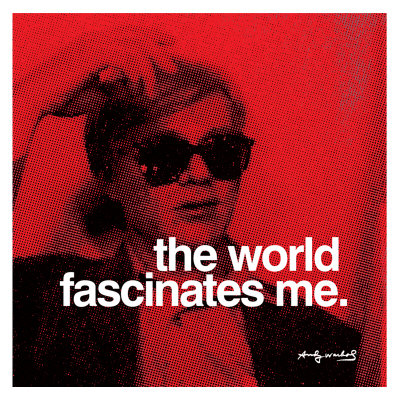 The colorful flurry that is the Annual Poster Sale at Messiah College ends today. I bought 3 posters for my blank, tack-compliant walls: two are Andy Warhol prints with wistful quotes, the other, a very artsy brown collage of triangles and swirls that form a center ascending swirly tree. I realize this means nothing to you (yet), but I still dished out $24 for these three pieces of paper, rashly spoiled by tiny corner tack holes.
If the poster sale was year-round, I would petition to change my senior thesis to examine this public phenomenon. But I suppose the rush of transience is something that makes this 2 DAY ONLY sale at least partially so appealing. But what makes the rest of it so darn appealing? Students from all years, all majors, and all styles meet in the commons to flip through awkward and robust poster books—the cheapest and smallest of these priced at $6. The commons in Eisenhower transforms from open lounge space to a space for visual and material consumption for the purpose of filling one’s own space with right imagery. From James Dean and Jamaica to Buddha and The Godfather, images of many shapes and sizes envelop a rectangle of tables by the mailboxes. The two cashiers have thick exotic accents; each year they do. But each year, I still have no idea who they are, where this business was started, and how it got affiliated with our Human Development and Family Sciences Department sponsoring the sale. But none of this seems to matter.
What matters is the magical usage these images have for people. I picked out three flat material posters, and it took some time, more than one trip, to decide on the right images. The images do something more than resonate with my life; they capture an elusive power gained by entering into them. Michael Taussig writes in his book, Mimesis and Alterity: A Particular History of the Senses, about an “active yielding of the perceiver in the perceived—the perceiver trying to enter into the picture and become one with it, so that the self is moved by the representation into the represented.”
Maybe this concept is a bit too harebrained and imaginary for the annual poster sale. Maybe anthropologist Michael Taussig, both fanatically worshiped and fervently hated depending on the group, is generally a bit too harebrained himself. But I believe my image browsing yesterday and today was shaped by cultural notions of individualism and representation. In turn, my decision to actually consume the images was shaped by the “original” (or perceived original) power captured by them, by entering into them. These posters are faithful “copies” of me, not because of their physical likenesses (there are none), but because of their self-extending faculties. We extend ourselves beyond our physical selves via other products too: Facebook, Blogs, wardrobes, cars, even majors (e.g. a student of Sociology and Anthropology). All of these production technologies provide powerful means for self-extension.
So whether you have “found” yourself in Marilyn Monroe, Johnny Depp, or the products of Salvador Dali, more power to ya. I could shame us all for being so shallow and consuming culture so irresponsibly. I could deconstruct the poster consumption chain or unpack the cultural logic behind my indulgences, if I had time. But instead, I'll just hang my posters, empowered by their sentiments and character with which I identify.
27 August 2009
Change I Can Believe In: (Mall of) America
1. An end to pairing the words “low” and “rise” on $60 jean tags, or any jean tags for that matter
2. A relocation of the pet store, currently situated in the Millcreek Mall's food court
3. A carpeted mallway, with shock resistant coils and/or free pedicure stations
4. A two-way lane system; U-turns permitted ONLY when trying to avoid hovering mall surveyors
5. An end to pairing the words “ultra” and “low” before “rise” on anything...ever.
2. A relocation of the pet store, currently situated in the Millcreek Mall's food court
3. A carpeted mallway, with shock resistant coils and/or free pedicure stations
4. A two-way lane system; U-turns permitted ONLY when trying to avoid hovering mall surveyors
5. An end to pairing the words “ultra” and “low” before “rise” on anything...ever.
02 August 2009
Gender Bender
Think you’re hot enough? asks a Taco Bell application for employment, picturing a single female manager on the front, wearing colorful clothing, cowgirl boots, hair down; and on the inside cover, the same woman in business pants, a tucked-in shirt, hair back.
Abby Richter is a romantically-challenged morning show producer whose search for Mr. Perfect has left her hopelessly single. She's in for a rude awakening when her bosses team her with Mike Chadway, a hardcore TV personality who promises to spill the ugly truth on what makes men and women tick, states Sony Pictures on its summer must-see film, The Ugly Truth.
These two culturally-ordinary excerpts share one thing in common: they are both unabashedly gendered.
Taco Bell doesn’t suggest that men should pass the hotness test to reach managerial status. Now, I love a good play on words (Taco Bell sells hot foods and hot sauces), but subtly challenging young women to prove their spiciness for employment seems at the very least one-sided (and ultimately a mediocre wordplay). An equally-gendered application asking whether or not you’re macho enough is missing. After all, this male-female, mars-venus, truth-emotion divide is real. The hotness question isn’t meant for men--it’s meant for the Gender commissioned to achieve equal shares of sexiness and independence, two ingredients that make for today’s hot enough woman (overseeing your fast food orders).
In The Ugly Truth, Mike Chadway gives Abby Richter a similarly enlightening commission: “You have to be two people, the saint and the sinner, the librarian and the stripper.” Luckily, Abby heeds Mike’s advice and proceeds to snag the ultimate catch, her new surgeon neighbor modeling an obvious spray-on tan.
Well there it is, the ugly truth that so many romantically-challenged, hopelessly single women have been missing out on! Thank God for Mike Chadway and his fearless crossing into the wilderness called femaleness. Abby is romantically-challenged because she works too hard. She is in a position of power, but lacks the sex side, her true other half. She is hopeless because her relationship strategies are outdated, stiff, and cleavage-deficient. But now, if only she can embody two people, the ultimate combo (meal) for men, her efforts will help her achieve ideal man-prey status.
Okay, okay, if you have seen the film (even if you haven't but you've seen at least 1 chic-flick in your life), we all know at some point it has to ease the woman-power rage it’s meant to stir. It has to show a soft side to Mike Chadway that explains his crudeness and makes women pity his splintered soul. Poor dejected Chadway; all he seeks is love, but because he’s been hurt in the past, all this “ugly truth” talk helps him cope.
Of course then, Abby realizes she hasn’t been herself with the surgeon, breaks it off with him (in a dramatic scene in which she removes her hair-extension piece), and falls head over heels for the man who’s been coaching her split-personality all along.
While the end seems to rectify all our haughty gut reactions to the film’s deluge of gender stereotypes , the ugly truth remains very gendered, perhaps just less unabashedly now. Floating up towards the heavens in a hot air balloon, Mike confesses his love for Abby, even though she is a "psycho aggressive freak." "I just told you I loved you and all you can concentrate on is [I can’t really remember, but something surely only a ‘woman’ would focus on]."
So in spite of our polarity, we can love each other, even if we don’t necessarily ever truly understand. The ugly truth we women got offended by early on is smoothed over by a “better” truth, one that says even though men and women are genuinely so different, love can be found and good sex can be had. But the underlying, "objective" truth still remains: men are from mars, and women, from whatever psycho planet we spawn from.
Is truth then the word we should really apply to the great gender divide-- a split made possible, graphic, and o so convincing by our desire to demarcate it? This divide is historical, cultural--that means it’s in our hands; it always has been. We construct what makes something more masculine than feminine, what makes a man effeminate, and therefore, less of a “true” man, and vice versa.
Perhaps the only ugly truth is the simple fact that gender norms are constructed--both authored and authorized by intricate cultural processes. The two-fold ideal wrapped up in today’s “hot”--that is, embodying both sexiness and power, both cowgirl swagger and management smarts-- is painted on our Taco Bell applications by human agents, not some organic, gender-policing force we have no control over. Gender is not black and white; it’s a complex, fluid product that we commodify, normalize, and entertain large audiences with.
Maybe it’s time to throw down our popcorn tubs from our separate planets and meet back on earth, start conversing, and work harder for personhoods based on individual qualities rather than gender models that usually piss most of us off anyways.
Abby Richter is a romantically-challenged morning show producer whose search for Mr. Perfect has left her hopelessly single. She's in for a rude awakening when her bosses team her with Mike Chadway, a hardcore TV personality who promises to spill the ugly truth on what makes men and women tick, states Sony Pictures on its summer must-see film, The Ugly Truth.
These two culturally-ordinary excerpts share one thing in common: they are both unabashedly gendered.
Taco Bell doesn’t suggest that men should pass the hotness test to reach managerial status. Now, I love a good play on words (Taco Bell sells hot foods and hot sauces), but subtly challenging young women to prove their spiciness for employment seems at the very least one-sided (and ultimately a mediocre wordplay). An equally-gendered application asking whether or not you’re macho enough is missing. After all, this male-female, mars-venus, truth-emotion divide is real. The hotness question isn’t meant for men--it’s meant for the Gender commissioned to achieve equal shares of sexiness and independence, two ingredients that make for today’s hot enough woman (overseeing your fast food orders).
In The Ugly Truth, Mike Chadway gives Abby Richter a similarly enlightening commission: “You have to be two people, the saint and the sinner, the librarian and the stripper.” Luckily, Abby heeds Mike’s advice and proceeds to snag the ultimate catch, her new surgeon neighbor modeling an obvious spray-on tan.
Well there it is, the ugly truth that so many romantically-challenged, hopelessly single women have been missing out on! Thank God for Mike Chadway and his fearless crossing into the wilderness called femaleness. Abby is romantically-challenged because she works too hard. She is in a position of power, but lacks the sex side, her true other half. She is hopeless because her relationship strategies are outdated, stiff, and cleavage-deficient. But now, if only she can embody two people, the ultimate combo (meal) for men, her efforts will help her achieve ideal man-prey status.
Okay, okay, if you have seen the film (even if you haven't but you've seen at least 1 chic-flick in your life), we all know at some point it has to ease the woman-power rage it’s meant to stir. It has to show a soft side to Mike Chadway that explains his crudeness and makes women pity his splintered soul. Poor dejected Chadway; all he seeks is love, but because he’s been hurt in the past, all this “ugly truth” talk helps him cope.
Of course then, Abby realizes she hasn’t been herself with the surgeon, breaks it off with him (in a dramatic scene in which she removes her hair-extension piece), and falls head over heels for the man who’s been coaching her split-personality all along.
While the end seems to rectify all our haughty gut reactions to the film’s deluge of gender stereotypes , the ugly truth remains very gendered, perhaps just less unabashedly now. Floating up towards the heavens in a hot air balloon, Mike confesses his love for Abby, even though she is a "psycho aggressive freak." "I just told you I loved you and all you can concentrate on is [I can’t really remember, but something surely only a ‘woman’ would focus on]."
So in spite of our polarity, we can love each other, even if we don’t necessarily ever truly understand. The ugly truth we women got offended by early on is smoothed over by a “better” truth, one that says even though men and women are genuinely so different, love can be found and good sex can be had. But the underlying, "objective" truth still remains: men are from mars, and women, from whatever psycho planet we spawn from.
Is truth then the word we should really apply to the great gender divide-- a split made possible, graphic, and o so convincing by our desire to demarcate it? This divide is historical, cultural--that means it’s in our hands; it always has been. We construct what makes something more masculine than feminine, what makes a man effeminate, and therefore, less of a “true” man, and vice versa.
Perhaps the only ugly truth is the simple fact that gender norms are constructed--both authored and authorized by intricate cultural processes. The two-fold ideal wrapped up in today’s “hot”--that is, embodying both sexiness and power, both cowgirl swagger and management smarts-- is painted on our Taco Bell applications by human agents, not some organic, gender-policing force we have no control over. Gender is not black and white; it’s a complex, fluid product that we commodify, normalize, and entertain large audiences with.
Maybe it’s time to throw down our popcorn tubs from our separate planets and meet back on earth, start conversing, and work harder for personhoods based on individual qualities rather than gender models that usually piss most of us off anyways.
04 July 2009
Aggravations
- How to Turn Your Child's Attitude in One Minute or Less program
- The deluge of Made in China U.S. flags swamping our neighborhood lawns
- The man occupying my usual booth and thwarting my power cord usage, who talks and laughs like the Penguin from Batman
- A coffee shop with advertised FREE WIFI but a total of two electrical outlets
- THIS SONG, which Philadelphia has been over for months, but Erie thinks is just the coolest
- And THIS SONG
- In sum, pop radio
- Seeing your HS basketball coach, whom you got fired, at the same nightlife spot as you
- Writer’s reluctance, not just block
- The Tom Ridge Environmental Center, which used to be a Drive In, and could have brought many more dollars to Erie if it had just stayed one
- Potholes
- Road construction to fix them
- Decelerating metabolism
- Accelerating languor
- Reader's reluctance, despite just ordering a super blog-worthy book: Why I am Not a Scientist: Anthropology and Modern Knowledge by Jonathan Marks
Subscribe to:
Posts (Atom)